Category Archives: ASEAN

Mekong study tour update: 7.19.2013

Other than top-notch commentary on China and SE Asia, ExSE isn’t known for too much and it’s quite clear now that keeping promises isn’t a strongpoint of ours. If you were expecting regular updates on our excursion to Thailand and Laos, we deeply apologize for not delivering. However, if there’s any worthy excuse, it’s that Brian, Dequn, Tai and I have been too busy learning. The following is simply a recap of what’s been going on so far; the true implications of the things that we’ve learned are too much for me to explore in any one post.

Our first two days were spent rather relaxingly, and thankfully far away from a 3G or broadband connection, taking a cruise down the Chao Praya River with Traidhos Three Generations Barges. On the cruise, we learned the river’s watershed, conservation efforts on the river and its significance to Thailand. It was a wonderful introduction to the country through its principal waterway.

The next morning, we met with Pete Cutter at the World Wide Fund for Nature Greater Mekong Office in Bangkok. The WWF Bangkok Office is involved in some very important efforts to preserve more than a half-dozen endangered species in the region and coordinates often with other NGO’s and governments in the GMS.

Our two days in Chiang Mai, where I’m writing from now, have been our most fruitful. Thanks to our friend and ExSE team member Tom Fawrthrop, we were able to meet with many of the top journalists, NGO heads and scholars in northern Thailand. On the 16th we had a lunch talk with Tom himself and learned a ton on the region in general, and specifically the dangers of the 1250MW Xayabouri Dam in the Lao Mekong and the movement to resist its completion. We then two lectures by Professor Narut and Professor Panuwat from the Chiang Mai University Political Science Department on Thailand’s economic role in the GMS and democracy in Thailand, respectively. Afterwards, we met with the Forest Restoration Research Unit at Doi Suthep National Park and learned about their groundbreaking research on tropical forest care. Continue reading →

Leave a Comment

Filed under ASEAN, Culture, Economic development, Energy, GMS, Governance, Laos, Mekong River, Myanmar/Burma, Thailand, water

China needs to change its energy strategy in the Mekong region

This op-ed was first published at ChinaDialogue and thethirdpole.net on 7/16.

 Mekong bridge

At the end of this year cars and container trucks loaded with goods from China and Thailand will finally be able to drive across a multi-lane bridge spanning the Mekong River (known as the Lancang in China). The bridge will connect Chiang Rai province in Thailand to Bokeo province in Laos, effectively linking China’s highways stretching south from Beijing and Shanghai to those coming north from Singapore, Kuala Lumpur and Bangkok.

Funded by equal investment from the Chinese and Thai government, the completion of the bridge, which took ten years of planning and two years to build, is not without controversy. For many years Thailand held back investment due to an uneven distribution of benefits between China, Laos and Thailand. Also on the Thai side, the NGO Rak Chiang Khong claim the bridge negatively impacts the local Golden Triangle economy and will ruin Mekong fisheries.

The Golden Triangle Bridge serves to highlight the challenges facing China, as the country’s new leadership attempts to balance its slowing and volatile economy and deliver domestic stability by maintaining peaceful economic relations with its neighbours.

China’s regional strategy

“In 2012 China’s growth in trade and outward investment with the five other Mekong countries of Myanmar, Laos, Thailand, Cambodia, and Vietnam surpassed its trade and investment growth in ASEANcountries,” said Xu Ningning, chairman of the Greater Mekong Subregion (GMS) Business Council. “Greater growth rates will continue with increases in regional cooperation and win-win investment opportunities.”

For the past three years China’s GMS provinces of Yunnan and Guangxi have posted growth rates of 12-15%, the highest of China’s localities, and arguably China’s economic rise has also helped deliver high growth rates among Mekong countries.

The end of the Cold War in the 1990s created a favourable environment for China to develop its economic cooperation strategies toward the Mekong region. The blurring and opening of once inviolable borders encouraged traders on both sides of the China-Southeast Asia frontier to appeal to local and national governments for better conditions for trade and migration. The Chinese government responded with twenty years of state-led trade liberalisation and investment policies to promote regional cooperation in state and private sectors.

China’s economic cooperation strategies towards its four Mekong neighbours has dovetailed nicely into a strategy that fits China’s current development needs. Liu Jinxin, a policy analyst and logistics expert says, “Unlike the US which leads the world in finance and IT, both high-value service-oriented industries, China is the world’s factory, producing goods to drive the growth of its growing middle class and serving export markets around the world. To survive, the Chinese ‘factory’ needs inputs like energy and raw materials.” Continue reading →

1 Comment

Filed under ASEAN, China, Current Events, Economic development, Energy, Environment and sustainability, Food, Foreign policy, GMS, Governance, Laos, Mekong River, Myanmar/Burma, Sustainability and Resource Management, Thailand, Vietnam, water

The Code of Conduct for the South China Sea: A Waiting Game

On June 30, 2013, following the China-ASEAN Foreign Ministers’ Meeting held in Bandar Seri Begawan, capital of Brunei, China released a joint-statement with ASEAN in a post-meeting press conference, indicating that they have agreed to hold “official consultations” on a proposed Code of Conduct (CoC) to govern South China Sea “naval actions”. All parties agreed to move forward with consultations in upcoming meetings to be held in China during September later this year.

Misleadingly or mistakenly billed as a significant paradigm shift by many English language news outlets, this development should not have come as a surprise to anyone. As early as November 2012, China already issued a joint statement with ASEAN at the 15th ASEAN-China Summit in Phnom Penh, Cambodia, marking the 10th anniversary of the Declaration on the Conduct of Parties in the South China Sea (DOC) and agreeing to “keep momentum of dialogue” in moving towards a formal Code of Conduct (COC).  China also reiterated this commitment in April this year, following the 19th China-ASEAN Senior Officials’ Consultation.

For the casual observer, keeping track of the ins-and-outs of numerous ASEAN-China agreements and cryptic diplomatic sparring over South China Sea (SCS) disputes can be daunting. News reporting differs greatly depending on its country of origin and the same story can be told in a hundred different ways leaving entirely different impressions of what happened. The following is a breakdown of the important historical, political, and legal considerations necessary to understand what the Code of Conduct for the SCS is, why it is important, and how it may eventually come about. Continue reading →

2 Comments

Filed under ASEAN, Brunei, Cambodia, China, Current Events, Energy, Foreign policy, Indonesia, Laos, Malaysia, Myanmar/Burma, Philippines, Regional Relations, Singapore, Thailand, Vietnam, water

A Day at the Fair: Impressions from the China-South Asia Expo

IMG_6432

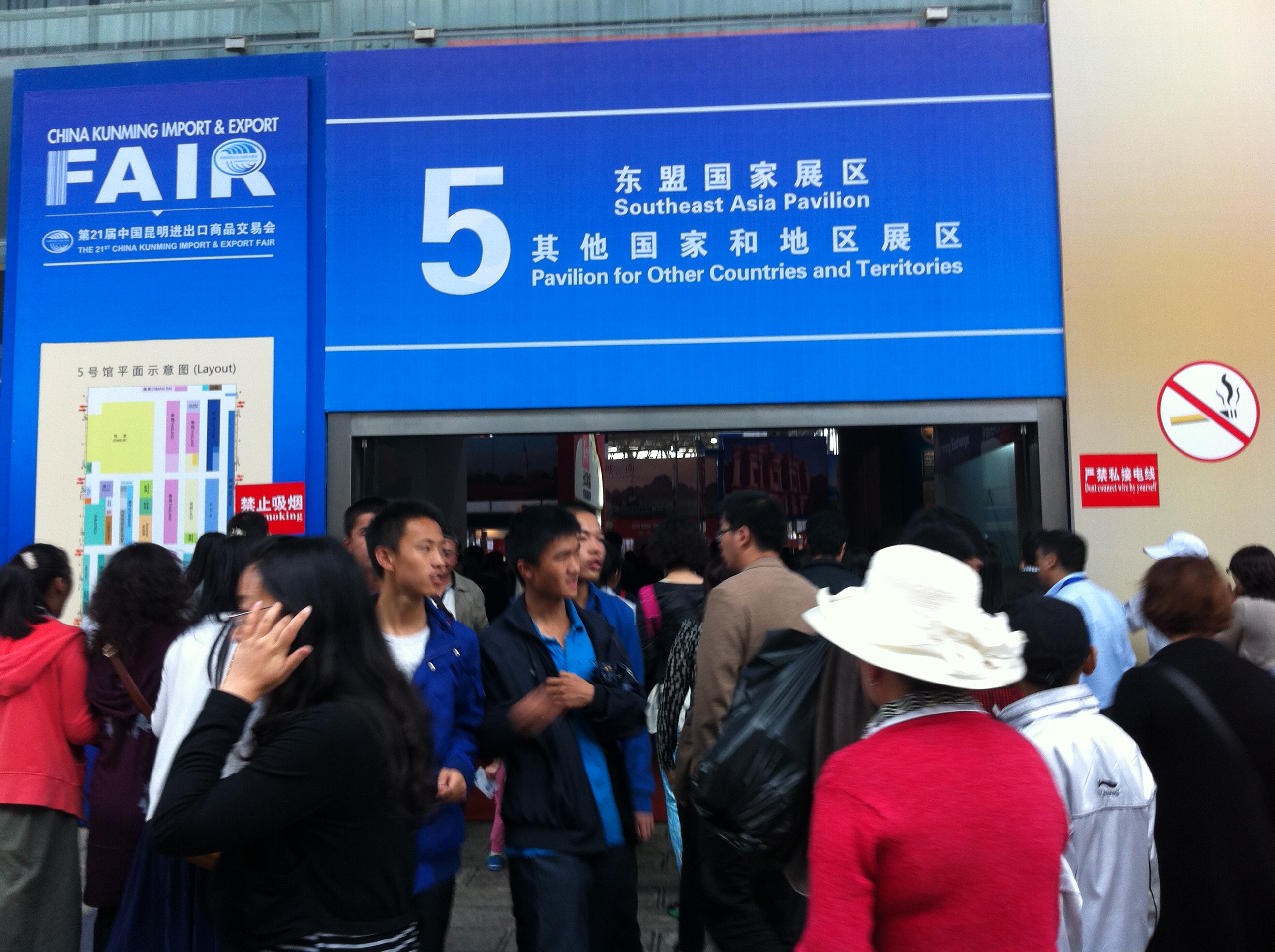
After much excitement on the part of merchants and nervous anticipation on the part of the local authorities, Kunming’s 1st Annual China-South Asia Expo came to a close on Monday. By all accounts the Expo was a great success and went off without a hitch. Fellow ExSE blogger Brian Eyler and I both attended the trade expo on Monday afternoon; the following is a record of our visit.

Monday was not only our most ideal time to attend the Expo, but it also was perfect for most other Kunmingers as they had the day off in honor of Dragon Boat Festival. Therefore, the lines were long and pavilions packed, and it took us more than 45 minutes to finally enter the Expo itself. Our first stop was the Main Hall, where the opening ceremonies were held. Flags from every country represented at the Expo and throngs of visitors taking a rest on the floor. A looped video promoting China-South Asia ties was playing in English with Chinese subtitles. However the English was worded awkwardly and sounded like it was copied directly from Google Translate. Both Brian and I agreed that future consideration towards the translation of materials might make a better impression on international visitors to the Expo given English is designated as the normative language communication between China and South Asia.  In the Main Hall we were stopped by a friendly group of local Expo volunteers who wanted us to be part of their souvenir photo collection. Continue reading →

Leave a Comment

Filed under ASEAN, Brunei, Cambodia, China, Culture, Current Events, Laos, Myanmar/Burma, Yunnan Province

Southeast Asian Football: The Long Game

When one thinks of great football (soccer) nations, countries like Brazil, England and Germany quickly come to mind. And turning to Asia, South Korea and Japan are perennial challengers at the all the big tournaments and veritable football powerhouses. Southeast Asian countries, on the other hand, are not known for their prowess at the beautiful game, which is why it came as a shock when the ASEAN Football Federation (AFF) announced last month that they would bid for the 2034 World Cup.

For those thinking that 20 years is a long time to plan ahead for a World Cup, it is. The formal bidding for the tournament won’t even start until 2026 and most other hopeful hosts won’t begin the planning stages for some years. But ASEAN states aren’t France or Argentina when it comes to football, and considering the amount of work ahead of the AFF, 20 years might actually be necessary for a successful World Cup bid.

Continue reading →

1 Comment

Filed under ASEAN

A Primer to the Philippines’ South China Sea Arbitration Challenge to China

Earlier in January this year, the Philippines submitted a unilateral challenge to China on certain key aspects of their ongoing dispute in South China Sea (SCS) maritime delimitations under the United Nations Convention on the Law of the Seas (UNCLOS). This challenge will take the form of an arbitration case before the International Tribunal on the Law of the Seas (ITLOS). To the uninitiated, this move is intriguing but unclear as to its real-world implications for international maritime law or the future of SCS geopolitics. The following primer attempts to translate the dense jargon of maritime law, distill the meanings behind subtle diplomatic language of Claimant States, and untangle the intricate web of geopolitical maneuvering to provide a clearer, layman picture of this case and its implications for the SCS disputes.

Why the arbitration case?

The ongoing dispute between the Philippines and China has been simmering for many years. Ever since a joint exploration agreement (along with Vietnam) to conduct seismic review of potential hydrocarbons in the SCS region collapsed in 2007, the tone and intensity of SCS disputes have escalated.  The situation came to a head when in early 2012, Chinese Coast Guard ships came into confrontation with a Philippine naval ship over harassment of fishermen in Scarborough Shoal, a formation in the Spratlys (南沙in Chinese). The Scarborough Shoal standoff did not end well for the Philippines as China has now established an ongoing blockade of the shoal. (More discussion of this standoff and its implications to follow in a later article) In response, the Philippines moved for ASEAN to issue a unified statement to China censoring it for its actions in the South China Sea. However, other ASEAN members proved reluctant to do so for many reasons. (More discussion of this will come in a later article) Suffice it to say, by Fall 2012, the Philippines began actively exploring other options to pursue its dispute with China.

What is happening?

To the layman observer of SCS disputes, the Philippines’ move to challenge China by arbitration may have been surprising. After all, it’s generally understood that China studiedly avoids multilateral engagement on SCS disputes and/or 3rd party mediation, insisting that the SCS disputes are a regional issue that should be addressed on a bilateral basis. Questions regarding this case include:

  • Can the Philippines unilaterally bring China to arbitration? And if so, does China have to engage?
  • Regardless of China’s engagement, does the ITLOS have jurisdiction to rule on the challenges?
  • What are the points the Philippines is challenging?
  • Even if ITLOS has jurisdiction to rule on certain aspects of challenges put forth, what are the actual implications for SCS disputes?

Continue reading →

2 Comments

Filed under ASEAN, China, Energy, Foreign policy, Philippines, Regional Relations, Uncategorized, water

Regional Roundup for Week of 4.18.2013

Just the news this week. Continue reading →

Leave a Comment

Filed under ASEAN, China, Cold War, Current Events, Economic development, Energy, Environment and sustainability, Foreign policy, Governance, Health, Laos, Mekong River, Myanmar/Burma, NEWS DIGEST, Thailand, Vietnam, water

About East by Southeast

WRITE FOR US!  JOIN THE ExSE TEAM, contact us at eastbysoutheastmail@gmail.com

The East by Southeast team is made up of scholars, development professionals, logistics experts, environmentalists, green entrepreneurs, and policy makers. We all live and work in the region – some were born here and some are implants. It is in the framework of the wide variety of our opinions that we seek to promote a deeper discussion of regional challenges. Some of us write under pen names to allow discussion to flow freely.

In addition to blog posts, look forward to weekly new digests, book reviews, and data that will help better inform your understanding of this dynamic region.


WHY WE WRITE:

There are many good blogs about China and many from Southeast Asia, but it is surprising that there are few blogs looking at the connections between China and Southeast Asia given shared development challenges, centuries of historical and cultural interaction, and rising volumes of trade and people movement between China and Southeast Asia.

In the 1990s, nations and ethnic groups that were cut off from cross-border interaction during the Cold War began to reunite as peace spread throughout the region, and arguably, China’s rise has reinforced stability within the region to deliver deepened integration.  Fast forward twenty years, the region is home to some of the fastest growing economies in the world and rapidly changing urban spaces. It is also known for its abundance in natural resources and biodiversity, and development trajectories are converting those resources into cash crops and energy commodities for trade and consumption. On mainland Southeast Asia, a lack of policy coordination and communication between governments and stakeholders has already created a variety of trans-boundary issues like fisheries depletion in the Mekong watershed.  As a result, for the first time, the region faces threats to food security and a potentially gross mismanagement of its resource endowment.

In addition to the growing connections between China and Southeast Asia, the East by Southeast blog team will examine China’s footprint across its southern borders to provide answers to some of the big questions surrounding China’s global rise. We seek to understand the effect and return of China’s outpouring of aid and investment to its Southeast Asian neighbors and monitor changes in China’s approach to foreign policy as its interests spread across the region. We want to know how China’s neighbors are adapting to its rise and how effectively China’s soft power is spreading. There is much room for discussion and exploration of the gaps between China’s rhetoric on its peaceful rise in the region and its ability to continue expanding its resource base to feed the needs of a rapidly growing economy. Lastly, we are concerned with China’s adaptation and response to a new and concerted US foreign policy toward Southeast Asia.

From a different perspective, the blog team will look at how the space between China and its Southeast Asian neighbors is decreasing at a rapid rate as transportation infrastructure, advances in information transfer, and trade linkages reach across borders and states use what Yale scholar James C. Scott calls in his 2009 watershed work The Art of Not Being Governed, “distance demolishing technologies” to connect areas that were once the frontiers beyond all frontiers. For example, energy from hydropower plants is sent from Laos to the China’s east coast development zones, you can now drive a container truck from Kunming to Bangkok in less than a day on what was once previous non-navigable terrain, and in 2015 the ASEAN Economic Community promises to drop the barriers to the movement of labor and goods through the region. In addition to understanding the trajectory and obstacles of regional integration,
we want to explore how rapid and sudden improvements in connectivity reshape individual livelihoods, communities, and regional relationships.

There are so many stories to tell of the people who are shaping the region for better or for worse and of the people who are affected
by regional decision making. Narratives from the varied and violent histories of the Cold War, colonial, and pre-colonial eras can help demonstrate how history can inform the present challenges. In addition, the blog will expore many regional question marks such as the tenuous path to democratization in Myanmar (and Thailand and Cambodia), Kunming’s rise as the Bangkok of the north, a high-speed rail system through Laos, and the effects of salinization in the Mekong Delta.  Can cities and rural areas in the region learn how to provide each other with sustainable solutions to development challenges? Are there lessons to be taught as countries like Thailand, China, and Indonesia seek to escape the middle income trap?

The East by Southeast team is made up of scholars, development professionals, logistics experts, environmentalists, green entrepreneurs, and policy makers. We all live and work in the region – some were born here and some are implants. It is in the framework of the wide variety of our opinions that we seek to promote a deeper discussion of regional challenges. Some of us write under pen names to allow discussion to flow freely.

In addition to blog posts, look forward to weekly new digests, book reviews, and data that will help better inform your understanding of this dynamic region.

If you’d like to join the discussion, feel free to leave a comment after our posts, or if you’d like to contribute to the blog by becoming a team member, send us a message to eastbysoutheastmail@gmail.com.

1 Comment

Filed under ASEAN, China, Cold War, Current Events, Economic development, Energy, Environment and sustainability, Foreign policy, Governance, water