Tag Archives: China

Origins: A Study Abroad Homecoming

I did not study abroad to “have the time of my life” or “take it easy for a semester”. Don’t get me wrong—I love adventure. When I fall into a routine for too long, I often crave it. I have spent the past six summers traveling in some of the most remote areas of the world. Last winter, I took a Birthright trip to Israel and embraced my Jewish identity. So traveling to China should not have been a big deal—it should have been just another adventure. Another opportunity to learn about local culture while reflecting on my own privilege. But to me, studying abroad in China for four months was daunting. By returning to my birth country, I was committing myself to the unknown and opening myself up to heartbreak.

I have always been sensitive. Even in safe situations growing up, I often felt vulnerable and insecure. It is a miracle, really, that I have traveled so much, as new situations and environments often give me days-long stomachaches and have me calling home in an emotional upheaval. More surprising still is on every adventure, I opt to travel with all strangers instead of childhood friends, relatives, or classmates from home. But maybe I thrive on that very uneasiness. Maybe my restless side thrives on facing challenges and exploring new places, cultures, and people without a familiar face by my side. Even more accurate, though, is me pushing myself to explore my own identity.

IMG_8378.JPG

Identity is a loaded word. It has a different meaning in various contexts. Identity can encompass perceptions of self as well as others people’s perceptions of you. It can include religion, socioeconomic status, intellectual point of view, political stance. Identity can be defined in the context of one’s community, geographic location, educational institution. And that is just the brink of the layered, multi-dimensional term.

​The eve of October 24, 2014, I boarded a flight from my study abroad program in Kunming to Nanjing, China. It is no metaphor when I say my whole body was shaking in fear, anticipation, excitement, and angst. Truthfully, as I write this three months later, my body is still tense, my fingers trembling. It has taken me months to process, truly, those three days. I think I am still processing my experience—I don’t know if the processing will ever stop. Identity is tricky that way: it always changes. Identity can contradict itself while making all the sense in the world. My identity can restrict me and liberate me.

​That weekend, I returned to my birthplace, Yangzhou. At least we think it is my hometown. When I was three days old, the Yangzhou Social Welfare Institute (both an orphanage and a home for the elderly) states that its workers found me outside the gates. There were no traces of my birth parents. But I am nearly five-foot-nine and my city is known for its tall women. I take pride in that shared trait.

​Returning to Yangzhou was my top priority when I decided to study abroad in China. Initially, the program interested me because of its focus on regional development in Southeast Asia, the place I truly feel at home. Having dabbled in Chinese culture and Mandarin for years, I kept forcing myself to become interested in China. Yet those moments of interest never lasted. I easily could have studied in Thailand, Vietnam, or Cambodia. But that would have been the safe route. Conquering my fear of China and all its unknowns reminded me that I could be strong and face the world bravely. Coming “home” to Yangzhou seemed to be the natural test of my courage.

​This wasn’t my first trip back. In 2005, I returned to China with my family and one other family of three. The girl was my crib mate in 1994 and miraculously, our parents had connected through Families with Children from China, an organization dedicated to giving adoptive families support pre- and post- adoption. It is common for families to bring their adopted children back to their birth countries when they turn 10 years old. We traveled for three weeks, mixing heritage and cultural “homeland” experiences with the more touristy excursions. While in Yangzhou, we visited my orphanage; I met one of my caretakers. Since my parents adopted me at five months old, I have no recollection of China. But I created memories during my first return. I distinctly remember one boy who gripped onto my finger and refused to let go. I recall an infant in a neon-pink fleece crying and throwing her bottle across the nursery. I still feel the pang in my chest as it hit me for the first time: that was once me. I was once in a crib, wanting to be held, nurtured, cherished as someone’s own loved one. During that visit, I presented the orphanage director with a scrapbook of my life in New York. I included a page that said, “I am a Jew, and Proud, Too” as well as photos of my dear grandparents meeting me for the first time at JFK Airport.

​Now, nearly ten years later, I had the opportunity to “come home” to my orphanage again. If you could still call it that. A decade ago, there was a master blueprint for reconstruction. Now, the upgrades have been completed. The new and grand center replaces the old one. Wooden floors and smoothed-cement walls replace the linoleum and dilapidated cinderblock. The former cracked marble sign at the entrance has been replaced with a sleek glass panel. The first floor of the center has been converted to a museum that celebrates successful adoption stories, including a photo of John Huntsman and his family.

Entrance to the Yangzhou Social Welfare Institute

​I did not recognize this place. Maybe that was good, as it meant the needs of the new children were being met. The demographics of children have shifted: it went from, in 1994, being mostly abandoned infant girls to, in 2014, being a majority of mentally and physically disabled boys who span from infancy to middle-school age. I recognize that state-of-the-art physical therapy equipment and play areas are rare in Chinese orphanages. Yangzhou is a welcomed, successful anomaly. But a selfish little part of me wishes there was some memory of the old building, whether it be a metal crib, the dim lighting, or the familiar smell of hot powered milk.

​This new building felt sterile. The lack of crying children or chaos made me feel as if I were in an artificial environment. Most of all, though, I felt that with the tearing down of the old building, I was no longer part of this community. I was once again a perpetual outsider, someone looking into her past without a tangible connection. I was disconnected from one more part of my Chinese heritage. It hurt.

​Of course, this is false. The building I saw ten years ago was a remodeled version of what my parents had witnessed twenty years ago, in 1994, when they adopted me. Everything changes all the time. Nothing slows down just because you want to reminisce.

​But reminisce I did. A public relations worker pulled my file from the archives. Inside the cardboard box, carefully preserved, was my father’s business card, a copy of my Chinese birth certificate, my adoption records, and the scrapbook I had brought nearly ten years ago. Although the construction paper had faded, I was instantly comforted. Here, inside the new, smoothed walls of the orphanage, a part of me remained. I laughed as I saw the “I’m a Jew, and Proud, too” page, especially in the wake of my Rosh Hashanah encounter in Kunming. Being just five days before the two year anniversary of my grandpa’s death and the one year anniversary of my grandma’s, I gulped back the sobs as I flipped through pages of photos of me in their arms.

​It’s unnerving, this concept we call time. It distances us from pain, yet in one moment, one photo can trigger sorrow and joy simultaneously. Seeing those photos of my grandparents sparked emptiness in my heart that I hadn’t felt since their respective funerals. Yet at the same time, I was overcome with relief. Relief that I still remembered their comforting hugs. Reassured that they weren’t slipping from my memories or my grasp. Hopeful that they would be proud of my journey and the person I am becoming.

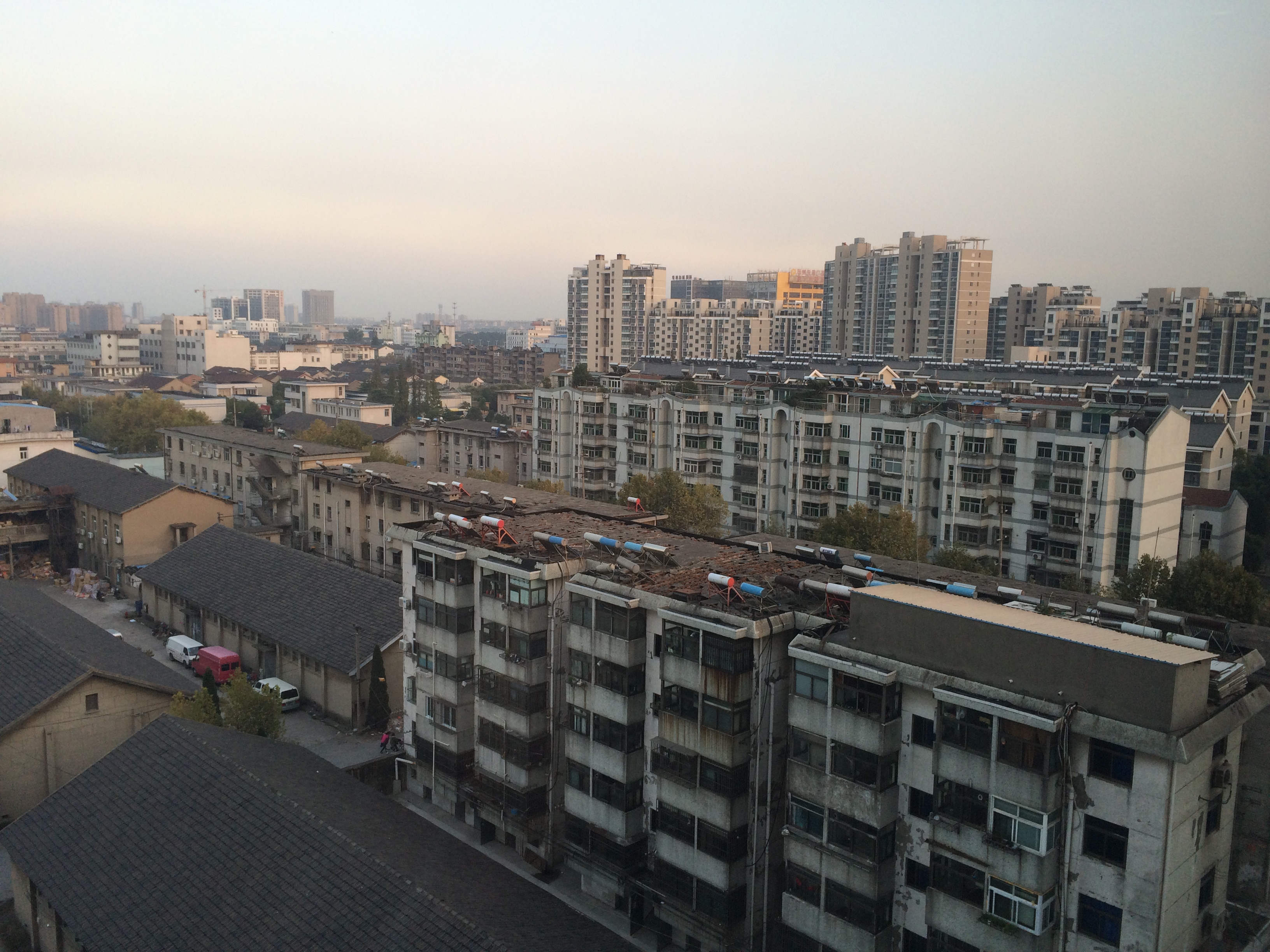
Skyline of Yangzhou, China.

Skyline of Yangzhou, China.

​Even Yangzhou the city was unrecognizable. Ten years ago, roads on the outskirts of the city were unpaved. The canals were beautiful but trash lined some of the older cobblestone streets. Rickshaws were the vehicle of choice. This time, electric motorbikes filled the paved streets. Trash bins and recycling cans sprinkled the sidewalks. There were Western toilets. It was unrecognizable, yet I felt at home. In the market, a woman asked me if I was a Yangzhou girl. Without hesitation, I answered “Yes” and she smiled. For once, I was a local, no questions asked. Unlike Kunming or other parts of China, where my native language does not match my face and my name does not complement my complexion, in Yangzhou, I did not feel like I was letting down others’ expectations of who I should be. Instead, I was candidly, unapologetically me. And no one countered this fact. Even when I fumbled my Mandarin, people smiled patiently. I explained to a shopkeeper that I was a Yangzhou girl but an American, too: I was returning home for a visit. She gave me a “welcome home” hug. I felt no resentment from her, unlike I have from other Chinese who discover I am internationally adopted.

​This is not to say that I fit in perfectly. I was still at the crossroads of my identity. But I felt accepted and I felt an inner calm. I have only felt this calm in Southeast Asia. Even in the United States, the land I call home, I feel out of place. Often, my inner anxiety exacerbates microaggressions, or non-conscious remarks others make about my identity. The expectations of others have become a burden to me. It is my nature to aim to please others; I hate letting people down, even if I have no control over the situation. My time in China has taught me that I have more grit than I give myself credit. It was four months of discomfort, yet I survived. No. I did more than survive; I grew up. I learned about myself. Sure, I learned that I do not want to live in China for the long-term. But I also learned that I am capable of it.

​Returning to China, overall, was not a homecoming for me. If anything, I felt alien. But going to Yangzhou gave me a new sense of what coming home could feel like. Home does not always have to be a place of comfort. It does not have to be familiar. Instead, it can be entering a new place and having a sense of calm wash over you at the same time new questions enter your mind. Coming home can feel like leaving home, and the familiar, simultaneously. I left New York and Southeast Asia, the places I feel safest, and traded them for China, my country of origin. But New York could be my nation of origin, as well. It was where I was given a family, and put down my first real roots. Even Southeast Asia could be my origin: it is the first region where I let go of every insecurity and allowed myself to live freely, unapologetically, and out of my comfort zone.

​My study abroad journey taught me about Southeast Asia, sure. Yes, I learned basic Mandarin. Of course I built up my spicy-food tolerance. But really, study abroad is not about the academics. I learned 5% about the country, but 500% more about myself than when I set off. Cliché as it sounds, the self-discovery process was difficult and rewarding. There is no tangible measure for understanding identity, yet I feel myself observing, questioning, learning, and adapting. My semester in China has taught me to cope with internal struggles and insecurities while exploring who I am—and testing my emotional strength—in a new society. I have lost count of how many times my sense of self has been turned around and twisted. And with every bend, my confidence has faltered. Yet coming to China has made me stronger and more independent. I have new survival tactics. I have learned to channel my vulnerabilities and emotions, turning it into productive and positive energy. I’ve encountered people of all backgrounds who have vastly different agendas and means of getting there. I have furthered my understanding of “informed global citizen” and have pushed myself to become a responsible rising one.

1 Comment

Filed under China, SLIDER

Zen & the Chinese Art of Motorcycle Driving

Photo courtesy of GoKunming.com

Photo courtesy of GoKunming.com

One cloudless August day in 1998, I rented a bicycle and rode straight through the heart of central Beijing. It was the kind of day China’s capital never sees anymore — expansive blue skies, crisp, clean morning air and virtually empty city roads.

I cruised alongside hundreds of other riders crowded into bike lanes nearly as wide as the adjacent avenues. Bicycles dominated the city, outnumbering vehicles ten to one, with most being one variation or another of the classic Flying Pigeon. The riders all moved together in improbable synchronicity, like a shimmering shoal of fish. The lanes were extremely crowded but it felt as if the shoal carried me along and I effortlessly kept pace with everyone else, propelled by the exhilaration of facing my first day in China.

Fast forward to now, after more than 16 years in the country, and I struggle to find ways to keep that exhilaration alive. These days I ride my off-road motorcycle through the streets of Kunming trying my hardest not to flip the bird at every driver that gets in my way. This year, after a decade and a half of self-control, I finally let it fly. I took my right hand off the throttle, thrust my upraised fist toward the offending driver and extended my middle finger to the sky.

I was full of rage and hoped to provoke the same rage in the driver. I wanted to ruin his drive as he had ruined mine. Instead, the driver lifted his index finger, pointed at me and smiled. I could see him mouth two words to his friend in the passenger seat. “Kan! Laowai!” — Look! Foreigner!

I bought my first motorcycle in 2002 when I lived in Dali. I had never even ridden one before, but I planned a solo road trip north along the borders of Myanmar and Tibet. I didn’t have any idea what to expect, even strapping a machete to the side of my saddle just in case a band of ruffians threatened trouble. I never needed the weapon.

The countryside roads weren’t without their dangers. Tractors tore out from side roads without warning. Dogs, chickens and even children seemed to appear out of nowhere. But obstacles aside, I fell in love with China’s countryside and my mind raced with ideas of where to ride to next. With one twist of the throttle I was off to new adventures, making up songs and singing them as loud as I could over the roar of the engine.

But now, after more than a decade of driving in Kunming, I have been transformed. In place of gleeful songs, only obscenities broadcast from my helmet. I tear through the city as if I’m the Road Warrior on the run from murderous bandits. I honk my horn at every intersection as a warning to anyone who dares cross my path. Traffic rules mean little and courtesy even less. At times I feel like the Hulk — usually I’m the mild-mannered Bruce Banner, but with a spark of the ignition, the beast is unleashed.

In the past, I always obeyed traffic rules. I never got a ticket, made sure to yield the right of way and rarely honked my horn. More importantly I never lost my cool. Why then am I now so tempted to throttle so many that cross my path on the city roads? Or perhaps a more intriguing question is: Why am I becoming more and more like the very drivers I detest?

With a traffic culture that favors the aggressive and impatient, it is easy to blame everyone else for turning me into this creature. It is actually more dangerous being a law-abiding driver than an aggressive and selfish one. If you go too slow or stop for a crossing pedestrian, you might end up getting rammed from behind. And on a motorcycle, the safest place to be is out in front of all the traffic. Speeding or running a red light is sometimes the best way to stay out of harm’s way. On China’s roads, it seems that only the strong survive. Unfortunately, this is an attitude that derails any prospect of efficient traffic.

There are very few parts of the world outside of China that have ever seen such an immediate growth in urban traffic. Over the last decade, the number of cars on the roads in cities like Kunming has increased more than tenfold. Urban planners and law enforcement have struggled to adjust. The roads have widened and the laws continually change, but cities need more than just the stroke of a pen to adapt. Efficient traffic systems can’t just be instituted. They are cultural and evolve over time.

The safety of everyone on the road is best guarded when cars yield to motorcycles, motorcycles to bicycles, and bicycles to pedestrians. But the pecking order has been lost and so too has any proper ‘right-of-way’ mentality. Instead, roads in China are often plagued by many who cling to a sense of entitlement. Motorists feel as if they have earned the right of way just by the very purchase of an automobile. And those who can afford even more expensive cars feel that much more entitled. They drive brand new black BMWs, flashing their brights and honking their horns warning everyone ahead – ‘VIP coming through!’

Every time I mount my motorcycle, I do so knowing exactly what to expect. I know that someone will cut me off. I know that an electric scooter will dangerously tear through a red light right as I cross an intersection. I know that some fancy car behind me will honk its horn, urging me to acknowledge his self-importance. So why should I let it surprise me or stir my fury when I know exactly what is likely to happen? Expecting the worst is the best way to avoid the worst. And it should be a lot harder to get angry when I know what is coming.

China has changed at a rate never seen before at any point in time anywhere else on the planet. Everyone is racing to find their place in society, making sure that they don’t get left behind. Traffic culture is only one manifestation of this, and it is constantly evolving. Today’s traffic might be closer to a frenzy of sharks than a shoal of fish, but I’ll be better off passively following the current than angrily fighting against it.

After the middle finger incident earlier this year, I decided that before expecting change from any of the others sharing the road with me, I needed to at least be more responsible for myself. I’ve stopped expecting everything to fix itself all at once, and I try my best to be a part of the evolution by incorporating a little more common courtesy into my daily drives. I am increasingly amazed by how much I receive in return.

This doesn’t mean that I don’t still curse motorists that cross me from time to time, and it certainly doesn’t mean that I am now a perfectly patient driver. But the next time I let the middle finger fly free, I’ll at least try to do it with a smile.

Leave a Comment

Filed under China, SLIDER, Yunnan Province

The Red Line, Bottom Line, and Direction of State-Owned Enterprise Reform (translation)

China's president Xi Jinping discussing State-sector reform in December 2013.

China’s president Xi Jinping discussing State-sector reform in December 2013.

Translators note: This essay was first published in Qiushi’s online journal Red Flag in early June and then recirculated on various CCP and government websites/publications including the official CCP News website, SASAC website, and most recently SinoPec’s  official site.  Its analysis provides key insight into the both the nature of China’s coming state-owned enterprise reforms and challenges to launching reforms.  

The author, Zhu Jidong, first outlines that the reforms will not be a massive sell-off or a granting of private and foreign firms access to state assets as many pundits have suggested, but rather a reform that re-introduces corporatization and mixed-ownership structures to China’s state-owned firms.  The essay continues with a discussion of the connection between the importance of state-owned industries and the survival of the Chinese state and Communist Party.  It touches on the dangers and risks of reform going off in a wrong and misguided direction and hints that power currently is unevenly distributed in the state-owned sector and that managers of state-owned industries could continue to use their power to make arbitrary decisions, engage in corrupt practices, and take advantage of reform.  The author calls on the Party and governments from the central to local level to promote the supervisory powers of various societal sectors to ensure the coming reform process is fair and transparent.  He encourages Party commissions and local governments to set up hotlines using various forms of social media for observers and whistle-blowers within the state-sector to utilize in reporting malfeasance and corrupt practices that occur during the coming round of state-owned enterprise reform.

 The timing of this essay’s release is critical as state-owned enterprise reform should be a key issue discussed at the coming 4th Plenary Session of the 18th Party Congress this fall. To date this is the essay’s only known English language translation.


 The Red Line, Bottom Line, and Direction of State-Owned Enterprise Reform

Deepening state-owned enterprise reform is a major undertaking and is a major issue gaining attention and controversy around the future fate of the party and the state.  During the “two sessions” of 2014, General Secretary Xi Jinping stressed that state-owned enterprises cannot be undercut but rather must strengthen.  State-owned enterprises must absorb the experience and lessons of past reforms and state assets cannot turn into an opportunity for speculative profiteers amidst the wave of reform.  The underlying spirit of this essay is to further advance the definition of state-owned enterprise reform’s red line, identify the bottom line, and clarify its direction.

Drawing the red line: Speculative profiteering opportunities cannot be made in the name of State-owned enterprise reform

“Decision of the Central Committee of the Communist Party of China on Some Major Issues Concerning Comprehensively Deepening the Reform,“ the document produced during the CCP’s Third Plenary Session of the 18th Party Congress clearly states for the positive development of a mixed ownership economy.  There are those who advocate the position that the development of mixed ownership economies will serve as a big push to advance privatization, to permit more private and foreign enterprises to control the shares of state-owned enterprises while at the same time allowing state-owned enterprises to retreat away from competitive sectors.  This has created a certain mindset of confusion throughout society.  Looking back at more than 30 years of Reform and Opening, the loss of state assets during the process of state-owned enterprise reform has been a controversial topic which triggered many problems.

Some people say that the purpose of reform is to sell state-owned enterprises, as if success is only delivered through wholesale sell-offs and the price of the efforts of privatization is the laying off of large quantities of employees. A sentiment exists that not only can state employees not share fruits of this kind of reform, but they also serve as the sacrifices of reform; further the state must shoulder the welfare burden of this heavy issue.  Correspondingly a minority state-owned enterprise upper management who once carried the torch of reform have become billionaires.  Now there are even those who advocate “To mix is to sell, if you don’t sell you can’t mix.” If the name of reform is to forcibly make state-owned enterprises sell off rights and assets to private and foreign enterprises, then state-owned enterprises are not strengthened, rather they are weakened..

Developing a mixed ownership economy calls for open and transparent principles. Some people stress that the process of developing mixed ownership is to allow private enterprises to participate in the affairs of state-owned enterprises.  But if upper management of some state-owned enterprises take up this slogan and combine it with the efforts of private managers, then the possibility of “state assets becoming opportunities for private exploitation in the wave of reform” will arise. The crux of reform is openness and transparency and it is a reform to be carried out under the supervision of the masses.

The basic policy of developing a mixed ownership economy is already clear and its essence, as well as its success and failure, is in the details of regulation.  It is imperative for the transfer of state ownership and assets to be an open and transparent process.  Financial assets should be made known to exchange markets.  Transfers should be public knowledge.  State-owned enterprises should engage in open, fair, and just exchange.  The state should establish an institution with the sole purpose of managing, supervising, and quickly establishing a platform for the transfer of state ownership and assets and mandate all state-owned enterprises regardless of reputation to openly, fairly, and justly execute the transfer of state assets.  The private transfer or third party management of the transfer of state assets is impermissible. At the same time, this platform must be built to be as transparent as a glass window in order to put a stop to end all under the table dealings.

In order to develop mixed ownership economies it is necessary to guard against foreign capital controlling the pulse of the Chinese economy.  In accounting for the livelihood of the Chinese people, China’s state-owned industries not are not only the key sector for economic stabilization and boosting the economy, but these firms also bear the load of fending off the control of International monopolistic capital controlled by multinational corporations.  They take on the heavy task of protecting the security of the national economy, and because of this, frequently are a target in the eyes of Western countries and multinational corporations.  If foreign capital and foreign firms are to enter the reform of the state sector, we must first consider the question of the security of the economy and the security of the entire country.  Otherwise after foreign capital and foreign firms enter this sector, it is possible they will spy on the state sector’s confidential policies and strategic decisions.  One can easily imagine that this will influence the security of China’s economy.

A 2006 report issued by the State Council’s Development Research Center expressed that among industries already open to foreign capital investment, each of the top five firms in those industries were nearly completely under the control of foreign capital.  Particularly among twenty-eight major industries, foreign capital exploits the controlling rights to multiple forms of assets of twenty-one industries.  It can be said that foreign capital controls these twenty-one industries.  Today this data should be even more shocking.  Because of this, we must guard against foreign capital from taking advantage of mixed ownership economies to control the lifeline of the Chinese economy and threaten China’s economic stability.   We must take strict precautions against foreign capital from seizing the opportunities of national defense, railways, energy resources, telecommunication, public industries, and those that are associated with national security and major industries associated with the economic pulse of the state and people.

The development of mixed economies needs to allow for the participation and supervision by the masses.  We must appeal for the positive activation of the masses to supervise the whole process of the development of mixed ownership economies and absolutely cannot allow for the invaders to embezzle from and take advantage of state industries.  The party committees and governments at the central and local levels have all installed hotlines, mailboxes, and websites and are positively ready to receive reports on neglect, malfeasance, and corrupt activities associated with state enterprise reform. We will positively investigate and make public the clues reported by the masses pertaining to the loss of state assets.  Toward the actions and behavior of those who embezzle state assets, we will investigate resolutely and severely punish. Through dissecting case studies involving the loss of state assets, we will establish and strengthen the institutions to protect state assets and the benefits of workers during the process of state sector reform.

In the development of mixed ownership economies, we must prevent the torchbearers of this reform from carving up state assets for their own purpose.  The selling of shares to managerial levels and to employees is a topic that will attract much attention during this round of state-owned enterprise reform.  Some locals are already implementing models for share distribution, so this direction has already been established. State assets are legal assets owned by the people of the socialist state of China, and the spirit of state assets cannot be violated. No one has the right to turn these assets into the private assets regardless if they are at the managerial level or a common employee.  Importantly the leaders and employees of state-owned enterprises cannot grant distribution of shares to themselves or transfer all of the people’s assets into private assets.  To permit or even encourage employees and managerial levels to hold shares or to institute models for the holding of shares is a means to permit these people to buy enterprise shares using their own money –  not to carve up state assets for their own usage.

Identifying the bottom line: State enterprise not only cannot weaken, but it must strengthen

In the Communist Manifesto, Marx and Engels pointed out that: “The question of ownership is the fundamental issue of the movement.” The common means of production is the economic base of the socialist system and state-owned enterprises are the principal part and pillar of the common means of production.  The Constitution of the People’s Republic of China clearly stipulates common ownership economy is the guiding power of the economy of the Chinese people and the state.  The state must guarantee the strengthening and development of the state economy.  The development of a strong state economy is assured by the state economy’s controlling the economic lifeline of the people and the state.  In order to express the superior characteristics of the socialist system as well as provide national defense and social cohesion, it is critically important to strengthen the power of China’s economy.

Through controlling the economic lifeline of the people and the state, the state-owned economy can keep the entire national economy running and serve as the engine of development.  The state-owned economy is the effective means for macro-economic adjustment, adjusting market inefficiencies and for realizing the prerequisite conditions of national strategic planning.  Because of this CCP General Party Secretary Xi Jinping has emphasized, “State owned enterprises not only must not weaken, but they must strengthen.” Regardless of the manner of reform, we cannot go beneath this bottom line, otherwise we will end up on the wrong road.
Even after if the many years of privatization and liberalization in Europe, the state owned economies of many countries in many still occupy dominant positions in key sectors and state-owned enterprise investment takes up approximately 20% of total national investment.  For example, state-owned enterprise investment is more than 27% in France.  Moreover the French national government owns more than fifty-one enterprises and employs 838,000 people.  The income of these enterprises contributes approximately 15% of France’s GDP ranking sixth in Europe.  Norway’s government owns forty-six firms which employ 230,000 and contribute about 9.4% of national employment, levels these firms’ incomes comprised nearly 70% of Norway’s 2008 GDP, an increase of 10% from 2004.  Although post-Soviet economies went through a spurt of privatization, by and large, the state-owned sector of many powerful former Soviet states is extremely large.  Russia’s state-owned fixed assets account for 40% of total state assets and state-owned enterprises control nearly 50% of the economy, and state-owned enterprises account for 31% of total employment.  Moreover, the state owned economy comprises more than 70% in Belarus.  Perhaps this is the reason why Russia and Belarus have the confidence to not fear the West and even dare to stand up to Western hegemony.

A few foreign friends have also provided advice for the reform of China’s state-owned economy. On February 15, 2012, German Prime Minister Schmidt reminded China in an interview that the question of ownership reform is one of hundreds of trillions of RMB. Currently most state enterprises are monopolistic and relate to state security.  These firms should develop in the interest of long-term stability and are not for the purpose of profit-seeking as top priority.  The profits of state-owned enterprises are the profits of the people; if these state-owned enterprises privatize, they will not necessarily become more competitive, and they will not necessarily provide more benefit.  Schmidt used the railway system as a case in point: some of China’s western railways are seriously bearing too much weight and collecting too little in fees.  If the railway firms privatize, these railways might halt transportation or raise their price.  This will bring major (negative) impacts to the development of the country’s interior.  If foreign friends can clearly see the danger, should their words fall on deaf ears?

China’s 2012 GDP was 51.9322 trillion RMB and per capita income 38,354 RMB.   This is already higher than 6000 USD.  This makes China the world’s second largest economy.  Moreover the rapid development of China’s state-owned economy was the major guarantor of China’s reaching the rank of the world’s second largest economy.  It is also the major motivational fountainhead of China’s economic development.  The CCP’s “Decision of the Central Committee of the Communist Party of China on Some Major Issues Concerning Comprehensively Deepening the Reform” calls for the transitioning of a portion of state-owned capital to enrich social welfare funds, improve the budgetary system of state capital operations, improve the rate of contribution of state-owned enterprises to public finance.  The decision sets the goal of 30% contribution to public finance by 2020 in order to guarantee welfare benefits for the people.  Further, this reveals how state capital relates to all people, and it is only through the strengthening of enterprise that the broad masses can enjoy the benefits of state capital.

Let me ask, can the state enrich social welfare funding through foreign capital and private capital?  Can foreign capital and private capital act without conditions, not seek return on investment, invest in the infrastructure of impoverished areas or fend off earthquake, floods, and other natural disasters? The answer is obviously no.  Because of this, if China is to strengthen and is to allow the people to better enjoy the fruits of reform and development, it must demonstrate the guiding function of the state-owned economy, continuously increase the state economy’s vitality, controlling capabilities, and influence, and make this bottom line clear to the world.

Many people think of the selling off of state production rights and assets when they hear of mixed ownership economies and envision the single possibility of private enterprises and foreign enterprises entering into state-owned enterprises.  Actually the development of mixed ownership in no way should be or is a one-way concept.  Moreover, the development of mixed ownership is two-directional and even multi-directional.  Private and foreign enterprises can enter the state owned sector by purchasing production rights and assets, and state-owned enterprises can also purchase the production rights and assets of private and foreign enterprises and even control the shares of some private and foreign enterprises.  This is the true meaning of mixed ownership economy.

If the development of a mixed ownership economy means only the selling-off of state production rights and assets then the obvious result is the weakening of state-owned enterprises and not their strengthening. Because of this we certainly need to clarify that the development of a mixed ownership economy is not for the purpose of weakening state-owned enterprises and surely is not to privatize.  We need to promote dual directional and multi-directional mixed ownership structures of state-owned enterprises, private enterprise, and foreign enterprise and not simply sell off the production rights and assets of state-owned enterprises to private and foreign enterprises.

Setting the Course: Continuously strengthen the vitality, controlling abilities, and influence of the state economy

In order to promote national modernization, guarantee power the mutual benefit of the people, the continuous development and strengthening of state-owned enterprises is the major force that supports the rise of the Chinese economy. It is also the guarantor of the endurance, strength, and perfection of the party leadership.  “To continuously strengthen the vitality, controlling abilities, and influence of state-owned economy” is the direction set forward for reform in the state sector by the CCP’s 18th Party Congress.

State-owned enterprises should take steps of self-improvement and like a phoenix rising from the ashes take on social responsibilities, establish a proper image, and increase the degree of promoting the processes of reform.  This requires us take a serious look at  the existing challenges to the current development of state-owned enterprises and persevere to strengthen and perfect the party leadership and realistically strengthen the positive characteristics which promote the working class as masters of society.  We should take action in accepting the supervision of multiple levels of society, severely punish graft and corruption, and in the deepening of state-owned enterprise reform promote the continuous improvement of modern enterprise system.

At the high strategic level we must prioritize and continuously strengthen the vitality, controlling abilities, and influence of state-owned industries. As the corporatization of state owned industries attracts strategic investors and key groups, state owned property rights are diversified, and the vitality, controlling abilities, and influence of the state economy continuously strengthens.  But at the same time we can see that the existing problems within state-owned industries are many.  The salary differences in some state-owned enterprises are comparatively large even to the point of great disparity. Disparities exist in the execution of corporate social responsibility programs within some state owned enterprises.  The management method of some state-owned enterprises is careless and accidents have occurred, some state-owned enterprises’ modern enterprise systems are just for show or have large degrees of patrimony.  Some leaders of state-owned enterprises make arbitrary decisions, their lives are extravagant and degenerate, they practice nepotism, and even will sell off state interests for their own personal benefit.

These issues not only influence the initiative of employees, but also damage the vitality, controlling capabilities, and influence of the state-owned economy.  The report of the 18th Party Congress calls to stimulate new energies in various market sectors and calls for all state-owned enterprises to adopt a specific and realistic focus. Thus the increase, stimulation, and demonstration of these new energies is a major challenge that all state-owned enterprises and their leaders must face directly, and this challenge must be highly respected at the strategic levels.  The issue of how to continuously reform and increase the state-owned economy’s vitality, controlling capabilities, and influence is for the relevant departments, work units, and experts located within the Central level’s  Leading Groups on Comprehensive Deepening of Reform to deepen research and determine the right path, polices, and regulations.

We must clearly see that from the distribution of industries, to date 90% of state-owned enterprise are outside the realm of competitiveness.  A slogan such as “Allow state-owned enterprises to leave the realm of competitiveness” is a covert argument of those who support privatization, and the basic motive of those who support privatization of state enterprises is to destroy our party’s economic base.  We must prioritize at a high degree how to scientifically develop a mixed ownership system while preventing new losses of state assets and guard against people from taking advantage of state assets in a new round of privatization.  To develop mixed ownership economies, we should select a portion of firms within a portion of industries as demonstration sites and expand the scale of development after summarizing experience and learning.  We must act accordingly to the path, policies, and regulations set by the central government in order to orderly develop mixed economies and prevent a mad rush.

We must persevere to strengthen and perfect the party leadership of state-owned enterprise reform.  General Party Secretary Xi Jinping has stressed many times “China is a major power, and we absolutely cannot allow any subversive errors.” What are subversive errors?  It is those errors of directionality which depart from the fundamental characteristics of socialism. And it is on this point that the 3rd Plenary of the 18th Party Congress stresses that comprehensive deepening of reform must strengthen and perfect party leadership.  Serving as the resolute leadership core of China’s socialist cause, the CCP naturally also forms the leadership core of China’s economic construction and serves as the leadership core of state-owned enterprise reform.

During the coming reform of the state-owned sector, we must demonstrate the offensive and defensive functions of party organs and the vanguard and model nature of party members.  Further we must dare to shoulder responsibility and resolutely confront all erroneous words and deeds.  It is only through perseverance in strengthening and perfecting the party leadership that the existing degeneration, extravagant waste, and nepotism within state-owned enterprises can be solved. We must unite and lead the masses the struggle against the activities of those who would embezzle state assets in order to maintain the right direction of state-owned enterprise reform. The nature of mixed ownership economies is decided by who controls shares. This is the central issue. The Central government should not give up shareholding rights in the name of state-owned enterprise reform.  Moreover, the Central government cannot change the characteristics of strategic enterprises.  This is what is meant by persevering to strengthen and perfect the party leadership as a strong base and powerful safeguard.

We must strengthen the master status of the working class.  Strengthening the master status of the working class is to continuously strengthen the vitality, controlling abilities, and influence of the state-owned economy’s solid base.  The working class is China’s leading class.  It is the representative of China’s advanced production force and production relationship.  It is our party’s most solid and most reliable class base and the comprehensive construct of a moderately prosperous society.  Lastly, the working class is the main force of upholding and developing socialism with Chinese characteristics.  To uphold and develop socialism with Chinese characteristics, we must rely on the working class with our whole hearts and whole minds and strengthen the master status of the working class to realize the full function of the working class as a main force.

In recent years the issue of corruption has arisen within state-owned enterprises and within some industries to the point of extreme severity. A contributing factor to this corruption is that the master status of the working class is wrongly viewed.  Some leaders and cadres within state-owned enterprises do not take supervision by the working class and the interest of workers to heart, and for their own personal benefit, these leaders will sacrifice the interests of workers and the state.  Relevant documents have expressed that the gap between actual average salaries of leaders of centrally owned enterprises to their employees is exponentially widening.  This has raised questions and criticisms in some enterprises.  When developing the mixed-ownership structure, state-owned enterprises should consider the raising of employee’s salaries.  Actually many centrally owned enterprises achieved rapid improvement and synergy in increasing industrial efficiency and employee’s salaries when shifting to mixed ownership.

Chen Jieyuan, Party Secretary and Board Chairman of the Shanghai Port Group LLC said, “In recent years, The Shanghai Port Group, through has experience the sweet taste of mixed ownership.  From 2006 when we fully listed on the market, our net assets have doubled, profits have basically doubled, and employees’ incomes have doubled.  These three “doubles” mark the direction in which state-owned enterprise reform should persevere especially in the process of developing mixed ownership, priority should be placed on promoting the distribution of shares to employees, establish a modern enterprise system, and fully raise income of employees.

The data shows that in 2010 the average income of an employee in a state-owned enterprise was 38359 RMB, 5% higher than the national average.  The average income of an employee in a private enterprise was 20759 RMB, 43% lower than the national average.  It is obvious which kind of enterprise serves as a better model for increasing the incomes of workers.  Because of this, the only way to strengthen the master status of the working class is to continuously increase the income levels of employees in the private sector, not the other way around.  Relevant organs at the central level should come up with a proposal for the distribution of shares to employees based on rigorous surveying and research and make this a major breakthrough point for feasibly strengthening the master status of the working class.

We must require state-owned enterprises to accept supervision from many levels of society.  This is the major guarantor for the continuous strengthening of the vitality, controlling ability, and influence of state-owned enterprises. We must open various channels of supervision, promote and accept the supervision of the masses, and accept and participate in supervision of the process of mixed ownership reform.  We must also draw from the concepts and management experience of private enterprises and foreign enterprises. Party committees at the central and local levels and governments should set up whistle-blower hotlines, mailboxes, and websites and accept reporting from all levels of society on malfeasance, dereliction of duty, and corruption during the process of state-enterprise reform. Concerning state-owned enterprise reform these committees should take advice and suggestions from various societal levels, and make use of the body of people’s wisdom and power to make good on state-enterprise reform.

Especially with the rapid development of the internet, online news, Weibo, Wechat, forums, blogs, podcasts, these broadcast formats provide the best arena and platform for the people to supervise government and fight corruption in an ever-strengthening manner.  Relevant organs should organically integrate educational experiences from the mass party line and pure and clean frameworks into the reform of state-owned enterprises.  These organs should positively involve the participation of the masses, make progress in using the internet, and widen and open to the masses channels for reporting corrupt practices.  Anti-corruption departments must especially focus on clues related to the loss of state assets which are revealed through reporting from the internet, and encourage and direct the masses to report on the egregious ways and issues of corruption through legal methods.  Those who would attempt to transfer state assets into personal exploits should be called out and swatted like mice crossing the street. This is the way to uphold the core status of common ownership.

About the author:  Zhu Jidong is a researcher at the Qinghua University Research Center for College Moral Education.  Holds a post-doctorate in Marxism Theory, is Head of China Academy of Science World Socialism Research Center and General Secretary of National Cultural-Security and Ideology Research Center.


Leave a Comment

Filed under China, Current Events, Economic development, Energy, Governance, SLIDER

Understanding China’s housing reforms

hukou


Xinhua News Agency reported in late July on the government’s planned hukou reforms, which will begin by facilitating the urban settlement of roughly 100 million people who do not hold urban IDs and which will ultimately lead to the elimination of discrete registration systems for urban and rural residents.

The hukou (huji or ‘household register’) system is about 4000 years old. Early in its inception it became an instrument for tax collection and by the 7th century BCE administrators in present-day Shandong were levying different regions according to different standards. The present system serves to maintain census data and severely limit migration into urban areas, making it analogous to the North Korean hoju or former Soviet propiska systems and earning it criticism as China’s apartheid by BBC News, The Independent and South Africa’s The Star.

Citizens currently registered in rural areas must follow a tortuous bureaucratic path in order to qualify for non-agricultural work and unless they successfully do, they will not receive the same educational or medical benefits as their city-dwelling compatriots. Government officials have defended the system by citing the need for stability but some, like Tim Luard of BBC News (here), have suggested the restriction of urbanization preserves a rural population in order to furnish state enterprises with low-wage workers.

Jasper Becker, former Beijing bureau chief of Hong Kong’s South China Morning Post, has written an engrossing account of the Great Chinese Famine entitled Hungry Ghosts: Mao’s Secret Famine in which he describes how local administrators, eager to impress, oversold the output of their districts. Corresponding taxes claimed the bulk of food production in many rural communes and, as a result, holding a rural hukou became a death sentence for millions even while urban residents dined well.

But officials remain wary of reforms that may trigger massive nationwide urbanization, leading to spikes in urban crime and stressing the limits of municipal resources and social services. So while the government works to improve the system, it does so with deliberate speed. Rural residents were given the right to work in urban centers years ago by purchasing temporary urban visas and Beijing has now announced plans to allow the movement of 100 million workers, roughly half the total number of illegal residents.

Major cities like Shanghai will retain tighter controls whereas urban districts with less than three million people will become easier for rural resident to move into, thus encouraging growth in mid-sized cities while protecting larger ones from overpopulation. The government’s stated long-term hope is the standardization of the nation’s system by 2020, allowing rural and urban residents to enjoy the same benefits and opportunities.

Leave a Comment

Filed under China, Current Events, Economic development, Governance, SLIDER, Yunnan Province

China and South Asia: Contention and Cooperation Between Giant Neighbors

Are China and India allies or enemies in the South Asian economy? Well, it seems they are both; working together in healthy and profitable partnerships while maintaining armies in the contested China-India borders. This article explains the paradoxical nature of the China-India relationship and its impact and implications for the smaller countries in South Asia and neighboring Southeast Asia.

The rise of China and India over the last two or three decades continues to make global news headlines. Competition between these two global powers in economic, political and diplomatic domains has garnered scholarly and media attention. Yet we know much less about China’s growing ties and contention with India that are also spreading across the South Asia subcontinent and beyond. As China-India trade has grown, India in 2006 opened the historical trade route, Nathula Pass, which had remained closed for almost 50 years as a result of a border war with China in 1962. Today in the presence of several persistently disputed border zones in South Asia (see Map 1), China is beginning to build dams on the rivers in the Tibetan Plateau, including the upper Brahmaputra (yarlung tsangpo or Yarlung River), which could impact populations living downstream in India and Bangladesh (see Map 1). China has taken over the construction of Gwadar Port in the Pakistani province of Baluchistan, on the Arabian Sea. China has also begun building the Gwadar road corridor all the way north to Xinjiang. Continue reading

Leave a Comment

Filed under China, Economic development, Energy, Foreign policy, GMS, Mekong River, Myanmar/Burma, Regional Relations, SLIDER, Uncategorized, Yunnan Province

Monsters in the Mekong

Construction of the Xayaburi Dam in Laos

Construction of the Xayaburi Dam in Laos

It will be a giant, stretching across the mighty Mekong River. Standing 32.6 metres tall and 820m wide, the $3.8 billion Xayaburi dam in Laos could supply electricity to more than three quarters of a million homes in Thailand. And when it’s completed in 2019, it will be the most controversial power project in the region.

Since the plan was released in 2010 to construct the hydroelectric plant, geologists and environmentalists have voiced concerns about safety and the effects the mega-dam will have on neighbours Cambodia, Vietnam and Thailand. They have highlighted the risks of seismic activity in the area and the threat to the fishing industry on the 3,100-mile long (4,900 kilometres) Mekong River, which flows from the Tibetan steppes into southern China on its way to Myanmar, Laos, Thailand, Cambodia and Vietnam. Continue reading

1 Comment

Filed under China, Current Events, Laos, Mekong River, Regional Relations, SLIDER, Thailand, water

China’s Humanitarian Policy in the Philippines: Politics Over People?

Image courtesy Bruce Reyes-Chow

Image courtesy Bruce Reyes-Chow

China has been no stranger to territorial conflict throughout its long and complex history, having met plenty of resistance while spreading its dynamic culture near and far. Today is no different, as intense disputes over tiny island chains in the South and East China Seas have left China in a state of particularly poor relations with some of its most important neighbors. These disputes, of course, do not bode well for maintaining reasonable terms over some of the region’s most important geopolitical issues. However, what has become equally as apparent—and potentially more important—is the way these conflicts are currently affecting the way China conducts humanitarian policies in the region. As China continues to rise toward the top of global power and influence, many assert that with it comes a rising role of global responsibility. What we have found thus far is that China does not appear interested in taking up that challenge.

After Typhoon Haiyan—an exceptionally powerful storm—roared through Southeast Asia in early November and devastated parts of the Philippines, leaving the country’s death toll at over 6,000, China surprised the global community by offering a meager $100,000 in humanitarian aid. This, compared to the tens of millions of dollars in aid offered by many of the world’s most powerful countries, was perceived as particularly frugal and, to some, downright disrespectful. Understandably, China received quite a bit of backlash for its decision and soon thereafter increased its contribution to $1.6 million and committed state medical resources to the areas of the Philippines most affected by the disaster. However, China’s initial contribution seemed to clearly define its true opinion on the issue.

Despite China’s late arrival to the hard-hit Philippines, its aid and assistance was, of course, still received warmly and excitedly by the victims. When a natural disaster afflicts a nation, political relations no longer seem to matter to many. Filipino residents greatly embraced China’s support. Gina Tubigon expressed her appreciation after China’s arrival ensured the survival of her sister-in-law, Elesea. A 75-year-old suffering from a chronic respiratory ailment that worsened in the wake of the typhoon, Elesea may not have lived through the storm’s aftermath had it not been for the assistance of the Chinese medical team. Relieved about her sister-in-law’s stabilized condition, Gina expressed her appreciation, noting, “I know the relationship between the Philippines and China is not good, but we’re very thankful for the help.” This purely honest and non-politically calculated sentiment sums up the importance of cooperative relations between the two nations. It also suggests the possibility that a lack of increased aid and assistance from the Chinese government may have caused Gina to lose her sister-in-law.

 Relations between the two countries have been tumultuous for some time. As China continues its unprecedented rise, with an increasingly strong military accompanying extraordinary economic development, its Southeast Asian neighbors have become more and more anxious about territorial integrity. As China’s claims to the region become more extensive, the Philippines has been bolstering its defense and maritime law enforcement—with the help of US support—and has sought endorsements from ASEAN during the process. The Philippines, just like many of its regional neighbors, has endorsed the US’s recent pivot to Asia, as a mechanism to balance against Beijing’s increased maritime objectives.

These exhaustive disputes have occurred between the two countries for decades, but have become further amplified in recent years, as China’s claim to maritime territory off the coast of the Philippines—the 200 nautical mile radius that makes up its Exclusive Economic Zone (EEZ)—has continued to expand. This includes a tiny rock called the Scarborough Shoal, which is no bigger that the size of a relatively small raft, yet vital to the two countries, as it holds important designation for charting territorial boundaries. The dispute between the two countries serves as a microcosm for a more general trend of tension and insecurity that has existed between China and its neighbors further south.

Though these tensions have persisted for many years, amplified to greater extents during certain periods more so than others, they have ceased to have a highly significant or long-term impact on trade relations in the region. Yet, China’s frugal initial response to Haiyan relief reflected a new realm of implications—that these strained relations are having a negative impact on how China is handling its humanitarian policy in the region. As the countries of East Asia continue developing economically, their regional interdependence grows in import. They must be prepared to support one another in combatting natural international crises that extend beyond politics, such as typhoons of the magnitude of Haiyan, especially when these crises have potential for mutually severe impact on multiple countries in the region.

China’s interest in extended control and influence over the region of the South China Sea—and East China Sea as well—has caused many to ponder whether Beijing also plans to embrace a wider role of responsibility regarding international crises. By offering such a small amount of financial aid during the immediate aftermath of this horrific storm, Beijing has implied that—at least for the time being—national interests remain the focal point of its current objectives, clearly trumping the need to be an international leader.

Of course, China’s stance toward the Haiyan relief effort is certainly not simple—with a range of complex considerations likely at play throughout the decision-making process. One fundamental question posed in response to China’s position is whether China is currently choosing not to emphasize the importance of more intimate relations with its neighbors—and the international community more generally—in order to instead commit more focus inward. As the Chinese government creates very carefully calculated strategies regarding domestic economic growth and infrastructural development, large numbers of financial resources and assets are presently committed to various projects throughout the country.

Indeed, China’s current national economic milieu is one of many different parts. These parts include initiatives such as western economic expansion, raising the standard of living for larger populations, developing the nation’s energy sector in a push for cleaner sources of fuel to drive the country’s future development, further establishing modern industries throughout different parts of the country (i.e. financial, technological, and creative/cultural sectors)—and many others. In addition, unprecedented economic progress has also instigated a range of complex social strains, some of which have never before been seen. Actively seeking to deal with these increasingly pronounced issues, such as frustration with appallingly high levels of pollution, larger interest in individual freedoms and self-expression among Chinese citizens, and rapidly evolving national identity—to list only a few—the Chinese government is carefully undertaking its national strategy.

As China consciously addresses these economic and social factors, simultaneous emphasis on non-political/economic international issues may not be on the immediate agenda. National leadership may currently ascertain that, still in an infant state of modern global importance and influence, this complex and highly dynamic country is not in a position to fully involve itself financially and logistically in these types of crises. However, regardless of China’s strategy with respect to regional and international stability—which at this point can only be speculated—what is clear is that China’s highly active position in geopolitical affairs has caused its western counterparts to expect a greater level of support from the rising giant towards these types of crises. Most important will be how China responds to this increased level of pressure and expected responsibility from its global economic partners as similar issues come about into the future.

Nevertheless, in the case of Haiyan, this is only but one event in the midst of a lengthy modern history of strained relations between these two countries that has fluctuated in degree over the years. Therefore, only time will tell if China’s increasingly powerful international role will cause the economic powerhouse to engage the international community differently into the future. In the meantime, the aid and assistance that China did eventually provide to the Haiyan relief effort was effective and surely prevented many from severe illness or death. The victims of the storm as well as those on the medical relief team were not considering regional political tensions as lives were saved. This kind of understanding and expectation will hopefully be at the core of decision-making between China and its Southeast Asian neighbors into the future, as a rapidly changing world seeks to prioritize people over politics.


Leave a Comment

Filed under China, Current Events, Foreign policy, Philippines, Regional Relations, SLIDER, South China Seas

Fire, Spirits and Ritual Self-Injury in Phuket: The Vegetarian Festival

Photograph by Amy Devlin (2013).

Fireworks explode in a loud cascade in the middle of the street, but no one flinches. I watch as a young barefooted man passes me – a pair of guns are impaled in his face, the barrels poking into the open flesh of his cheeks and out of his open mouth. He’s dressed in a black costume embroidered with Chinese symbols.

He is a mah song, a spirit medium, and he’s not the only one. Throngs of men and women are parading down the street, with metal skewers, needles, and even weapons inserted into their cheeks, arms, torsos and elsewhere on their bodies. They are in trances – their heads are twitching rhythmically, eyes rolled back, and their hands are clenched. Groups of devotees reverently carry statues of the gods. As far as the eye can see, everyone is clad in white. Continue reading

Leave a Comment

Filed under China, Culture, Current Events, Reviews, SLIDER, Thailand

Rubber and Sustainability in Southern Yunnan: A Tale of Two Villages

Will Feinberg compares Xishuangbanna’s rubber and sustainabilty in two of southern Yunnan’s ethnic villages. One monocrops while the other hedges.

Driving past new stores and half-built housing developments, you take a right into the forest. Keep going. The farther you drive, the worse the road gets until you burst through another patch of palms trees and cross a stream. Where are you? You’re in Mandian Village, just outside Jinghong, Yunnan and  right in the heart of Chinese rubber country.

Introduced to the area in the 1960s by the central government, rubber is big business in southern Yunnan. Large state plantations have steadily given way to private enterprises and the region has seen a proliferation of rubber planting in the past twenty years. Today in Xishuangbanna Dai Autonomous Region, which Jinghong is the seat of, rubber plantations already make up almost one fifth of all land.

While the environmental costs have been heavy, the rubber explosion has done wonders for Xishuangbanna’s economy. For rubber farmers in Mengla Country, for instance, the average household income is close to $30,000/year, comparable to places like Shanghai or Guangzhou. The economic benefits of rubber harvesting were quite clear to me while traveling through the region late last month. During the trip, I visited two villages that I had been to in 2011. In both cases, rubber has transformed the local economy, however one village was clearly better off than the other. Why?

The first village I visited was the aforementioned Mandian Village. Mandian is largely inhabited by people of the Dai ethnicity, with a 20-family group of Yi people living in an adjacent settlement. Mandian, like many other villages in the area, practices rubber cultivation and relies on rubber as its main source of income. According to villagers there, the Dai started harvesting rubber over a decade ago, while the Yi settlement began their rubber industry only within the last few years. For the village economy as a whole, rubber has had a positive influence. Per capita incomes have risen as well as household consumption and the money from rubber has allowed the town to build a new school.

However, as rubber is Mandian’s only cash crop, the village’s fortunes are now beholden to the world rubber market. Nothing illustrates this better than what happened to the village in 2012. Last year, the bottom fell out on the rubber market and the price of raw rubber dropped by half, going from 30 yuan per pound (1 US dollar is roughly equal to 6 Chinese yuan ) to 15 yuan per pound. Two villagers that I interviewed described the effects. One, a middle-aged Dai woman told of how most of the villagers who harvest rubber had to work overtime to scratch out living and the quality of life dropped for many families. Though because the Dai also plant rice, no one in the village went hungry. A young Yi woman that I spoke to also described how the economic hardships as a result of the rubber crash delayed the building of their house. The Yi, who were recently resettled as a result of the building of the Jinghong Dam, were forced to return to their old fields as a way of producing food during 2012 crash and without these fields, many villagers might have gone hungry. The fall of the rubber price in 2012 was not isolated just to Mandian village. The drop was felt in villages like Mandian all over southern Yunnan and in other rubber producing areas like Malaysia and Brazil. But there was at least one village that was comparatively isolated from the crash’s effects.

Nanpanzhong Village sits on the slope of a ridge just an hour’s drive from the Burmese border. A collection of some 120 families, Nanpanzhong is an Aini village. The Aini are a branch of the Hani/Akha minority, a nomadic, transboundary ethnicity that typically practice subsistence agriculture in the mountains of Southeast Asia. What makes the Aini of Nanpanzhong special, aside from their incredible hospitality, is their economy. Like the Dai and Yi of Mandian, the Aini also harvest rubber, but the role that rubber plays in the village’s economy is quite different. In an interview with the village mayor, I learned that money from rubber harvesting makes up only 30% of the town’s income. Instead, their primary source of income, by a long shot, is pigs. The town raises hundreds of short-eared swine which command quite a high price in China’s metropolises. According to the mayor, his pigs’ pork sells for 130 yuan/pound, many times higher than the price of normal pork. In fact, most of the village’s pork can only be found in places like Beijing, Chongqing and Shanghai; people in Jinghong can’t even afford it.

Pork sales now net the village almost sixty percent of its total income, but Nanpanzhong’s foray into the meat industry is a rather recent affair: villagers only began raising pigs in 2003. Its impact, however, has been astounding. According to the mayor, the average household income was hovering around 500 yuan per year at the turn of the millennium. Thirteen years later, that number as skyrocketed to almost 8,000 yuan and now, the mayor claims, Nanpanzhongcun is the envy of the surrounding valleys.

 When the rubber price plummeted last year, Nanpanzhong was largely unaffected. Of course, the mayor explains, villagers feel the effects when the rubber price fluctuates, but certainly less so than other places. The village is largely self-sustaining for food and the money earned from rubber, livestock and tea (which makes up a tenth of the village’s income) is used for electronics, vehicles and building materials. Both the mayor and villagers that I spoke with were convinced of the Nanpanzhong model’s superiority.

The evidence is hard to disagree with. Not considering the environmental concerns, of which there are many, rubber can be an unsustainable enterprise. Mandian, and hundreds of villages like it, have had a mixed experience with rubber. While it brought the village a new school and the villagers a higher standard of living, Mandian’s reliance on rubber and the fluctuations of the global market brought hardships to the village last year, forcing some villagers to leave in search of food. On the other hand is Nanpanzhong’s model. Rubber, while an important source of income for villagers, is part of a healthy balance. With families growing their own food and relying on two cash crops (rubber and tea) and livestock for their income, the villagers of Nanpanzhong are largely insulated from greater trends in the rubber market. The village’s exact model may not be able to be replicated in every village in Yunnan, but its general ideas can. Pairing rubber with a second cash crop and agricultural self-reliance are concepts that could give protection to villages like Mandian and offer a more economically sustainable path for thousands of people in the region.


Leave a Comment

Filed under Economic development, Food, SLIDER, Sustainability and Resource Management, Yunnan Province

Art Exhibition: Yin Xiuzhen, Nowhere to Land (Pace Beijing)

IMG_0457

It’s a microcosm of how rapid consumer-driven development has taken root in modern China: 798 Art District, once an esoteric artists’ enclave on the fringes of the city, has emerged as a prime tourist destination in Beijing, replete with international galleries.  Fashioned from a former military factory complex from the Mao era, industrial Bauhaus-inspired spaces serve as stark galleries for an array of contemporary Chinese artists.

Among these, the name of Pace Gallery may ring a familiar bell – earlier this summer, their sister gallery in NYC made a splash when Jay-Z rapped for six hours as part of a performance art piece.

In slightly more subdued fashion – but no less telling for the times – the irregular arches of Pace Gallery Beijing make a striking backdrop for Chinese artist Yin Xiuzhen’s current exhibition. In evoking the human aspects of globalization, Nowhere to Land is especially timely in the dynamic Chinese context, and Yin’s work gives a compelling account of what the view from inside the seismic changes of the country might look like.

Yin (b. 1963), a true Beijing native, presumably bears the perfect vantage point from which to witness the massive Chinese economic transformation. Since graduating from Capital Normal University in Beijing in 1989 with a B.A. in oil painting, the artist’s work has been featured internationally. Recent exhibitions include solo showings at the Groninger Museum in the Netherlands (2012) and New York’s MoMA (2010), as well as a smattering of group exhibitions in cities across the world, including Moscow, Shanghai, Venice, Sydney, Sao Paolo and San Francisco.

Yin’s work is all about the art of looking and deciphering. Incorporating homely, intimate and personal items into larger constructions, she emphasizes the superficial qualities of what seem at first impression to be straightforward sculptures. And in doing so, she problematizes the underlying assumptions behind glossy Chinese narratives of progress and globalization.

Yin Xiuzhen 2012_Nowhere-to-land

Yin Xiuzhen. Nowhere to Land. 2012. Mixed media.
Image courtesy of Pace Gallery. Continue reading

Leave a Comment

Filed under China, Culture, Reviews, SLIDER